
The "Return to Normal": Analyzing ATTOM’s February 2026 Foreclosure Report


The "Return to Normal": Analyzing ATTOM’s February 2026 Foreclosure Report
The U.S. housing market continues to navigate a path of normalization. According to the latest Foreclosure Activity Report from ATTOM, a leading curator of land, property, and real estate data, February 2026 marked the twelfth consecutive month of year-over-year increases in foreclosure filings.
While we are seeing a steady rise from the historic lows of the post-pandemic era, ATTOM’s data suggests a market recalibrating rather than a repeat of the 2008 housing crisis.
The Numbers: Starts and Completions
While total filings dipped slightly compared to January, the annual trend captured by ATTOM shows a clear upward trajectory for both those entering the process and those losing their homes to the bank.
Foreclosure Starts: Lenders initiated proceedings on 25,928 properties. This is a 2% decrease from January but remains 14% higher than February 2025.
Foreclosure Completions (REOs): Lenders repossessed 4,077 properties. While this is a 14% drop from last month, it represents a significant 35% jump from a year ago.
What’s Driving the Trend?
We are currently seeing the tail end of a "normalization" phase. For several years, foreclosure activity was artificially suppressed by moratoriums and government interventions. As ATTOM experts note, the current rise reflects the market returning to a standard baseline.
Why this isn't 2008: Despite the headlines, widespread homeowner distress is being held at bay by three major factors:
Strong Homeowner Equity: Most owners still have significant value in their homes, allowing for sales rather than foreclosures.
Tighter Lending Standards: The "subprime" risks of the past are largely absent.
Ongoing Demand: High demand for housing continues to provide an exit ramp for many struggling borrowers.
Foreclosure Hotspots: State Rankings
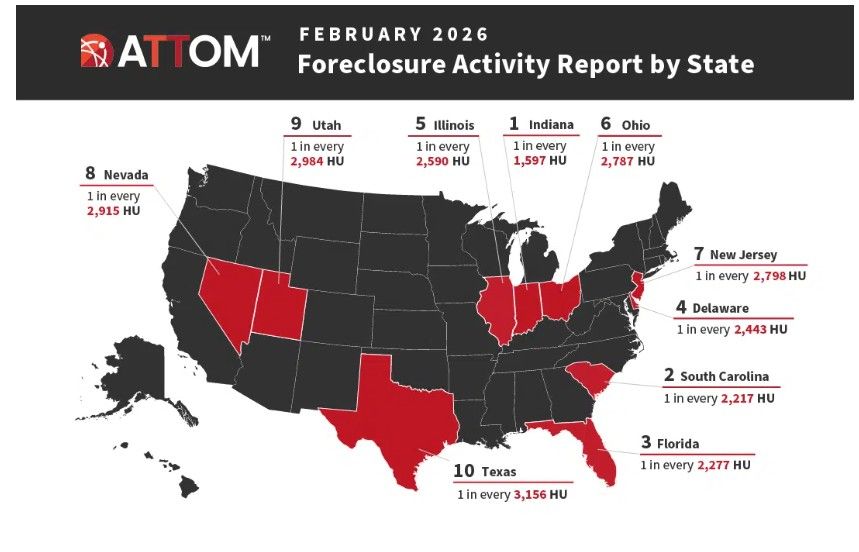
According to the ATTOM Foreclosure Data, Indiana currently leads the nation with the highest foreclosure rate, while West Virginia remains at the bottom of the list. Here is a look at the top 10 states where activity was most concentrated in February 2026:
Regional Insights
The data reveals interesting geographic clusters. While the Midwest (Indiana, Illinois, Ohio) and the Southeast (South Carolina, Florida) hold many of the top spots, Western states like Nevada and Utah are also seeing increased activity.
At the other end of the spectrum, states like Vermont (1 in 33,904) and West Virginia (1 in 43,066) show almost negligible foreclosure activity, highlighting the vastly different economic conditions across the country.
The Bottom Line
February's report from ATTOM is a reminder that while the "easy" days of near-zero foreclosures are over, the market is not in a freefall. For investors and lenders, this increase represents a return to a more active, predictable environment. For homeowners, the silver lining remains the robust equity built up over the last several years.